
Some places seem to have the power to slow our thoughts. Not because they are necessarily more beautiful than others, but because, for some reason, they help us forget for a moment everything we carry with us.
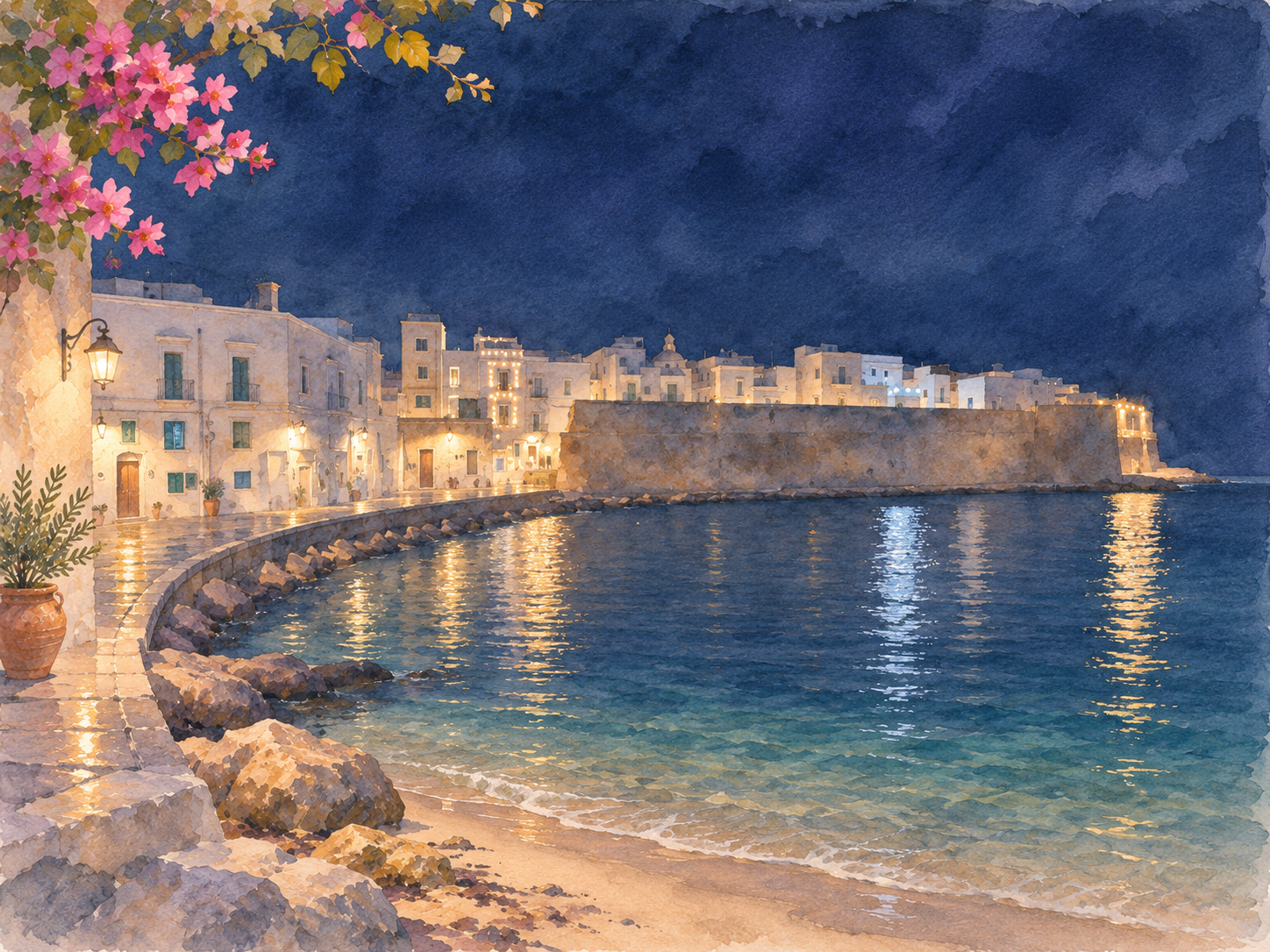
The other evening I was in Monopoli with my partner and Leo. We were walking along the seafront, between the lights of the houses and the reflections stretching across the water, breaking with every small movement of the waves. Before us lay the sea, with that low, steady sound that seems to have neither a beginning nor an end.
The silence of the sea is a curious thing. It is never truly silence. The water moves, breaks against the rocks, retreats and returns. Yet it can bring a sense of stillness that we sometimes cannot find even when there is no sound around us at all.
As we walked, I found myself thinking how little it really takes to make a moment meaningful. There was nothing extraordinary about that evening: a walk, the sea, the lights of a town. Yet that very simplicity led me to one of the hardest questions a human being can face: what truly makes a life worth living?
We spend much of our lives building something. We study to reach one goal, work to achieve another, wish for a better home, a different position, more security, more possibilities. And when we finally get what we were looking for, the satisfaction often lasts less time than we imagined. There is already something new on the horizon, another distance to close, another version of ourselves waiting to be reached.
There is nothing wrong with ambition. Perhaps the desire to improve is precisely what keeps us from standing still. But sometimes I wonder when we began to confuse making our lives better with continually filling them up.
As though a quiet day were necessarily a wasted day. As though free time gained value only when we could turn it into an experience, a trip, something to tell people about. As though simply feeling content, for no particular reason, were not enough.
Looking at the sea, I wondered whether we had learned to search for happiness so far away that we had become less able to recognise it when it passed beside us.
From there, almost without noticing, my thoughts drifted to the Aeolian Islands. To Filicudi, Alicudi and Lipari. Places I have always imagined living two profoundly different lives: summer, when tourists, boats, bustle and voices arrive; and winter, when much of that recedes and those who truly live there remain.
I wondered what it means to spend an entire life in a place where time seems to change speed with the seasons.
For someone arriving on holiday, an island is often a pause from ordinary life. You go there to escape the noise of the city, breathe different air and forget schedules and commitments for a few days. You look at the houses, the sea and the small paths, and find yourself drawn to the idea that life there might be more authentic.
But someone who lives on an island cannot treat it as a permanent holiday.
The very distance that means freedom to a visitor can become a practical difficulty for a resident. A ferry service dependent on the weather, a need that means travelling to the mainland, services that small communities cannot always provide on the same scale as a city. A place’s beauty does not erase the effort it takes to live there.
This is where my curiosity deepens.
I wonder whether people living on Alicudi, when summer ends and the village empties again, feel mostly relief or miss the bustle that has just passed. I wonder whether winter’s silence is a treasure to protect or a weight that sometimes becomes hard to bear. Whether distance from the rest of the world helps you find yourself or, at certain moments, makes you wish you were somewhere else.
There probably isn’t just one answer. And perhaps it would be unfair to imagine that everyone living in those places shares the same idea of happiness.
Some might deeply love that stillness, while others might wish for a different life. Some might feel the sea as a kind of freedom and others, at times, as a boundary. What is paradise to one person can become a cage to another, and vice versa.
This contradiction fascinates me. Those of us immersed in commitments often dream of slowing down. Someone living in an isolated place might wish instead for more opportunities, more encounters, more possibilities. Perhaps human beings have a habit that is hard to change: looking elsewhere for something we cannot recognise in the present.
And then the question changes.
It is no longer about deciding whether it is better to live in a big city or on a small island. Nor is it about deciding whether a simple life is preferable to a life full of ambition.
It is about understanding how much of what we pursue truly belongs to us, and how much comes from the habit of wanting what we see other people want.
A simple life, after all, is not necessarily a life without difficulties, responsibilities or big plans. It might simply be a life in which we can distinguish what matters from what merely takes up space.
Perhaps true wealth is not having everything, but recognising what we can do without. Not abandoning our ambitions, but preventing them from becoming the only measure by which we judge our lives.
Above all, it means not constantly putting off our right to feel content until some future moment, when we have achieved that result, bought that thing or solved that final problem.
Because in life, that final problem will probably never arrive.
At some point I found myself back there, in Monopoli. The sea kept moving, indifferent to the questions human beings have always asked. The lights reflected on the water, and our walk continued.
The world, of course, had not changed. The commitments would remain, along with the responsibilities and desires. I had found no definitive answer to the meaning of life, assuming such an answer could exist.
But perhaps there is something liberating in accepting that not every question needs a solution.
Sometimes it is enough to let them walk beside us.
I like to think happiness is not necessarily a place to reach, but an ability to nurture: recognising the value of what is before us, before it becomes only a memory.
Perhaps simplicity begins right here, when we stop asking for a moment what we lack and finally manage to see what is there.
A walk, the people to share it with, the sea in the evening.
That is all.
And sometimes, perhaps, that is already a great deal.